

Equipe: Low-dimensional oxides

Low-dimensional oxides – Nuclear quantum effects in oxides
Team Permanent members: Fabio Finocchi, Simon Huppert Emeritus researcher: Philippe Depondt Although the limits of classical statistical mechanics have been known for more than a century, in simulations, nuclei are almost invariably treated as...
Low-dimensional oxides – Reactivity of surface sites and defects
Team Permanent members: Gregory Cabailh, Stéphane Chenot, Fabio Finocchi, Jacek Goniakowski, Stéphane Guilet , Rémi Lazzari, Anna Levy, Slavica Stankic Emeritus researchers: Jacques Jupille, Claudine Noguera The reaction behaviour of oxide surfaces is often...
Low-dimensional oxides – Oxide ultra-thin films
Team Permanents members: Gregory Cabailh, Stéphane Chenot, Jacek Goniakowski, Stéphane Guilet, Rémi Lazzari Emeritus researchers: Jacques Jupille, Claudine Noguera The variability of the cationic valence, the incomplete screening of long-range interactions and the flexibility...
Low-dimensional oxides – Metal/oxide growth and adhesion
Team Permanent members: Gregory Cabailh, Stéphane Chenot, Fabio Finocchi, Jacek Goniakowski, Stéphane Guilet, Rémi Lazzari, Slavica Stankic Emeritus researchers: Jacques Jupille, Claudine Noguera Metal-oxide interfaces are used in a number of applications due to the...
Low-dimensional oxides
Founded in 2002, this team brings together experimentalists and theoreticians interested in the effects of dimension reduction in oxide materials. Thanks to a joint experience/theory collaboration, the group has developed over the past years a...
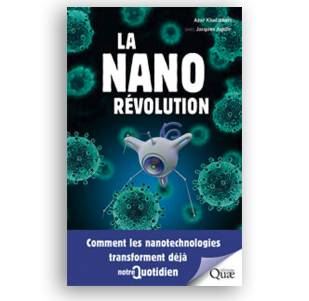
The Nanorevolution – How nanotechnologies are already transforming our everyday life
Odorless, colorless and invisible, nanomaterials have invaded everyday objects: candies and chocolates, paint and glue, clothing and medicine, yogurt and prepared food, beauty cream and toothpaste! Even packaging is teaming with them. Should we be alarmed? Applaud them or boycott them? This book underscores the complexity of problem once we take an overall look at it. It warns against simplistic solutions and advocates that consumers be fully informed.
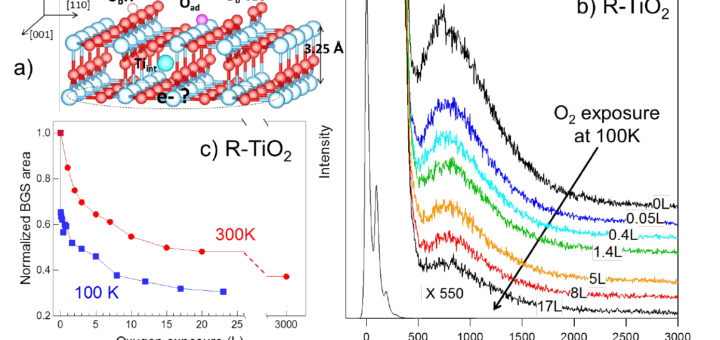
On the controversial origin of the band gap states of titanium dioxide
Currently used in self-cleaning windows and dye-sensitized solar cells, titanium dioxide TiO2 is a promising material for the photochemical purification of air and water or for hydrogen production via water splitting. Its particular photocatalytic...

