
Composite melting patterns
 Melting—the transformation of a solid into a liquid upon heating—is the reverse of solidification. Yet, despite the apparent symmetry, melting and solidification give rise to markedly different pattern-forming phenomena. In recent years, melting of multiphase alloys, a largely unexplored research topic, has regained attention, driven in particular by the rapid development of additive manufacturing techniques, which involve repeated cycles of partial melting and solidification. In this context, the PHYSURF team at INSP, in collaboration with a German group at Access e.V. (Aachen), recently carried out a study combining in situ solidification experiments with numerical simulations, considering a composite eutectic alloy. The researchers characterized the scaling behavior of eutectic melting patterns and uncovered several morphological transformations, including an unexpected period-doubling instability.
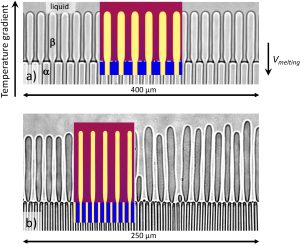
Figure: Eutectic melting patterns. The primary eutectic phase b protudes in the liquid in the form of thin fingers, while the secondary phase a melts at (approximately) the eutectic temperature. a) Thickening of the b fingers. b) Period doubling. In both cases, the melting velocity Vm was of 1 µm/s, but there is a large difference in the initial lamellar spacing. Gray-scale images: experiments (binary alloy: CBr4-C2Cl6). Color images: numerical simulations (phase field) using the physical parameters of the same alloy.
The solidification of eutectic alloys has been studied for many decades. It produces remarkable composite microstructures in the bulk material, which are a frozen trace of a self-organizing dynamics of coupled-growth, multiphase patterns at the propagating solid–liquid interface. In contrast, these microstructures provide the initial condition for melting – and, obviously, leave no trace in the liquid. Consequently, the mechanisms governing eutectic melting remain largely obscure unless the process is observed in situ. In collaboration with a group of theoreticians in Aachen, in charge of the numerical simulations, the INSP team performed directional melting experiments in which the phase transformation proceeds at an imposed velocity along an axial temperature gradient. A model transparent binary eutectic alloy in a thin-sample geometry—12-µm-thick films confined between two flat glass walls—enabled real-time optical observations of both solidification and melting.
The present study focuses on eutectic melting patterns as a function of two main parameters: the melting velocity Vm, ranging from 0.5 to 100 µm/s, and the interphase spacing λ. The pre-solidified microstructures were made of regularly spaced lamellae of the two eutectic solid phases. The spacing λ (ideally the spatial period) ranged from 5 to 25 µm and was primarily determined by the solidification velocity. Under these conditions, the eutectic melting patterns consisted of thin fingers of the “primary” solid phase protruding into the liquid, while the “secondary” solid phase melted close to the eutectic (three-phase equilibrium) temperature.
Various morphological changes were observed, and reproduced by numerical simulations. A progressive thickening of the protruding fingers at low velocity was identified and explained. Moreover, a period-doubling instability has been discovered, which leads to a melting pattern where the actual period is doubled (2λ) as compared to that of the lamellar spacing (λ). Based on the scaling behaviors of characteristic parameters, the present analysis provides clear evidence that, at large Vm, the morphology of the eutectic melting pattern is primarily governed by local diffusive coupling at the triple junction, while it is strongly influenced by the thermal gradient when Vm decreases below a critical value.
By combining in situ experiments and quantitative numerical simulations, basic physical phenomena at play during the formation of eutectic melting patterns were uncovered, including an unprecedented morphological transition to period-doubling shapes. Some open questions remain to be addressed that concern, e.g., solid-state diffusion and departure from local equilibrium at interfaces. Given the critical role of melting in additive manufacturing, this work provides a basis for further investigations into (i) the mechanisms underlying the onset of fragmentation and spheroidization of the primary-phase fingers at high melting velocities, and (ii) microstructure selection during repeated melting/solidification cycles.
Reference
« Pattern formation during melting of lamellar eutectics »
Nellissery Rajan, R. Kumari Rajendran, G. Boussinot, K. Sbargoud, S. Bottin-Rousseau, S. Akamatsu
Physical Review Letters, 136 (2026) 256301.
Contact
Silvere.Akamatsu(at)insp.jussieu.fr

