
Perovskite nanoplatelets examined from every angle
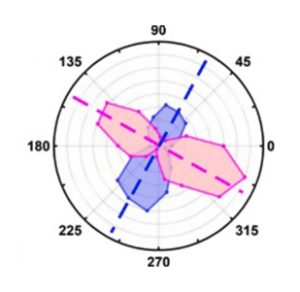 Colloidal nanocrystals of halide perovskites have attracted significant interest in optoelectronics due to their excellent optical properties, particularly their high quantum yields and the ability to tune their emission energies.
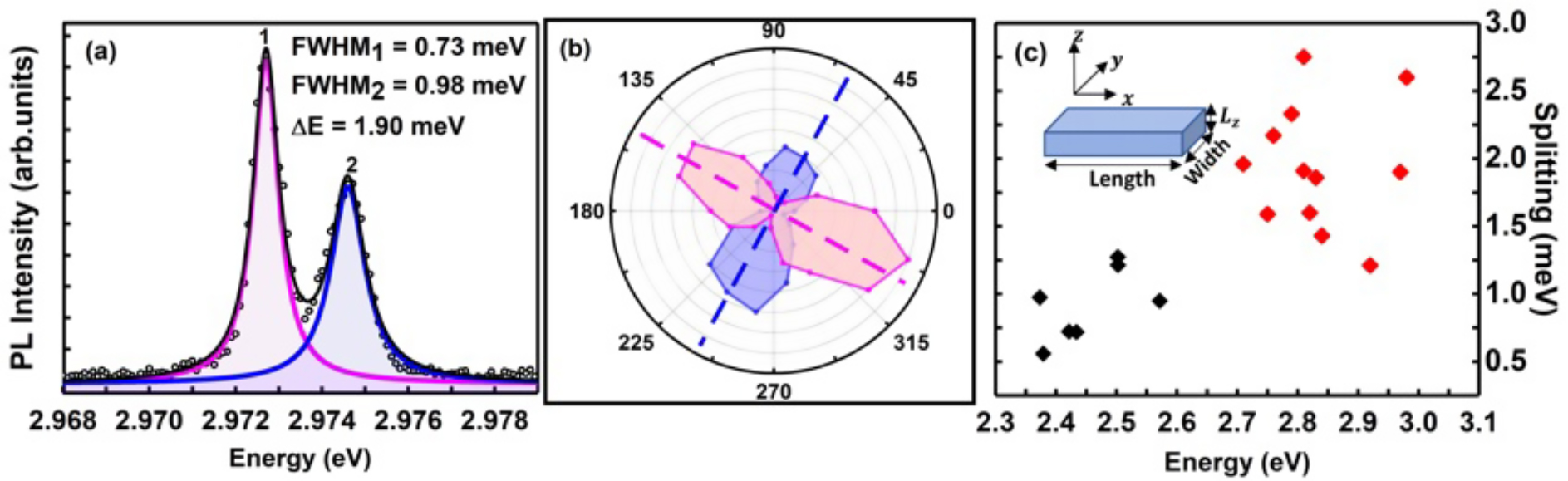
The PHOCOS[1] team has experimentally and theoretically studied the exciton emission of halide perovskite nanoplatelets, which can be regarded as quasi-two-dimensional quantum wells. A comprehensive model incorporating quantum confinement, dielectric effects, Coulombic interaction, and electron-hole exchange allows for the accurate reproduction of properties observed via optical spectroscopy and the simulation of the fine-structure of excitons as a function of the nanoplatelets size and shape.
This work highlights the major role of the dielectric environment on emission and provides a predictive model that can be extended to other colloidal nanoplatelets.
[1] In collaboration with the “Physical Chemistry and Surface Dynamics” team at INSP and the Laboratory of Materials Physics: Structure and Properties at the University of Carthage in Tunisia.
Figure
.
Reference
« Colloidal CsPbBr3 Nanoplatelets at the Single-Particle Level: An Optical and Theoretical Study »
Kaouther Tlili, Victor Guilloux, Violette Steinmetz, Thierry Barisien, Laurent Legrand, Emmanuel Lhuillier, Maria Chamarro, Kais Boujdaria, Christophe Testelin
Nano Letters 25, 15525 (2025).
Contacts
- Christophe Testelin : testelin(at)insp.jussieu.fr
- Laurent Legrand : legrand(at)insp.jussieu.fr

