Thermocolorimetry based on VO2 to Measure Thermal Conductivity
 Phase-change materials such as vanadium dioxide (VO2) are attracting growing interest because of their insulator–metal transition at temperatures close to room temperature. This reversible transition induces drastic changes in their electrical, optical, and thermal properties, paving the way for highly sought-after applications in photonics, thermal management, and thermal devices.
By exploiting the strong optical contrast between the metallic and insulating phases of a thin VO₂ film, used as a transducer, researchers at INSP have developed a new method of optical thermometry. Measuring, via optical microscopy, the spread of the metallic region under laser irradiation allows them to determine the thermal conductivity of solids from an analytical model of heat diffusion.
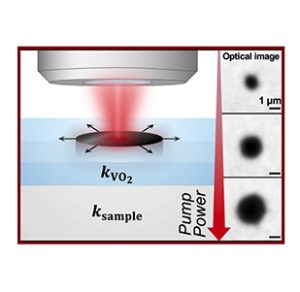
Figure Utilization of the insulator–metal transition of VO2 to measure the thermal conductivity of a material by steady-state optical microscopy. Reading the radius of the metallic domain as a function of the pump power enables this measurement.
Under illumination by a focused laser beam, the insulator–metal transition generates a metallic disk whose radius increases with the power absorbed by the VO2 transducer. The power dependence of this radius is measured by optical reflectance microscopy and compared to an analytical model of nonlinear heat transport, which includes the thermal conductivity of the substrate as a fitting parameter.
The method was applied to silica, sapphire, and silicon samples coated with polycrystalline VO2, by fitting the power dependence of the radius along the heating and cooling branches of the hysteresis loop. The thermal conductivities extracted for the three samples show quantitative agreement with literature values, covering a range (1–140 W m–1 K–1) both below and above that of VO2, which confirms the accuracy and versatility of the developed method for a wide variety of materials.
This study demonstrates the innovative use of a thin-film VO2 transducer to measure the thermal conductivity of a sample excited by a continuous laser beam. Unlike conventional thermoreflectance techniques, the operating principle relies on the insulator–metal phase contrast of VO2, providing enhanced sensitivity for measuring conductivities higher and lower than that of the transducer.
The simplicity of the experimental setup based on common steady-state optical microscopy makes this contactless approach accessible and suitable for a wide range of bulk and thin-film materials, with promising prospects for thermal conductivity mapping.
Reference
«VO2 Thin-FilmTransducer for Steady-State Thermal Conductivity Measurements»
Ilaria Delbono, Pascal J. Schroeder, Boris Kalinic, Carlo Scian, Irving Alonzo-Zapata, Frédéric Dumas Bouchiat, Corinne Champeaux, Tiziana Cesca, Giovanni Mattei, Danièle Fournier, James K. Utterback*, and Jose Ordonez-Miranda*
ACS Photonics, 12, 7002 (2025)
Contacts
james.utterback(at)insp.jussieu.fr
jose.ordonez(at)insp.jussieu.fr

