

Let’s Talk Parity – Careers in higher education and research: what is the glass ceiling or sticky floor?
Let’s Talk Parity is a series of short articles on concepts relating to parity that the INSP’s Equality-Parity referents have decided to set up.
Let’s Talk Parity: part 6
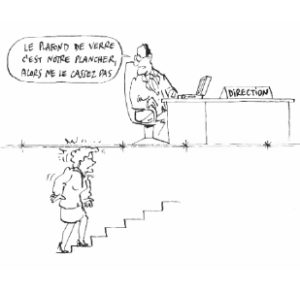
Careers in higher education and research: what is the glass ceiling or sticky floor?
In the wake of March 8, International Women’s Day, let’s talk careers!
At the CNRS, in 2021, 43% of permanent staff were women, including 37% of researchers. Across all disciplines, women accounted for 37.8% of CRs (research fellows) and only 31.7% of DRs (senior researchers) [1]. At the same time, women accounted for 45% of MCs (associate professors) at the university, but only 31% of PRs (full professors) [2]. This is known as the “glass ceiling.” It is this lower promotion rate for women that is the main reason for the €406 lower average gross salary for female teachers and researchers compared to their male counterparts (MESR, Note DGRH n°10, 2021).
The concept of the “sticky floor” illustrates the fact that the least skilled jobs are mainly held by women. For example, at the CNRS in 2021, more than half of tenured female IT staff are technicians or assistant engineers, while two-thirds of men are design engineers or research engineers.
There are many reasons why women’s careers are held back. These include persistent gender stereotypes in promotions, the Matilda effect, the boys’ club effect (already mentioned in previous episodes), and the difficulty of balancing personal and professional life.
To remedy this situation, the working group on obstacles to women’s careers in ESR [3] has made recommendations in several areas: remedying selection biases that may occur during promotions, contributing to a satisfactory work-life balance, strengthening overall equality policies within ESR structures, and encouraging the consideration of gender equality when funding research projects.
In terms of legal aspects, these include the introduction of indicators on pay gaps (egapro index) and indicators aimed at promoting equal access to ESR programs for female and male students (equality indicators derived from the Rixain law), as well as the law of July 20, 2023, which aims to strengthen women’s access to positions of responsibility for government employees.
Sources :
[1] CNRS : rapport social unique 2022 : https://carrieres.cnrs.fr/wp-content/uploads/2024/01/Livre_Rapport2022_WEB.pdf
[2] Vers l’égalité femmes-hommes – Chiffres clés, MESR, 2024 : https://www.enseignementsup-recherche.gouv.fr/sites/default/files/2024-03/vers-l-galit-femmes-hommes-chiffres-cl-s-2024-32097.pdf
[3] Sur les freins aux carrières des femmes chercheures et enseignantes chercheures au sein de l’enseignement supérieur et de la recherche en France Rapport final — État des lieux et recommandations Mai 2018 : https://www.enseignementsup-recherche.gouv.fr/sites/default/files/imported_files/documents/Rapport_freins_carrieres_femmesESR_1177048.pdf
To go further : Enquête 2022-2023 sur les écarts de rémunération au CNRS : https://mpdf.cnrs.fr/wp-content/uploads/2023/12/MPDF-analyse-remunerations-synthese-2023.pdf
Illustration: Delize

