
Do THz acoustic waves propagate in glass?
Glasses exhibit atypical thermomechanical properties that are very different from those of crystals. Many of these peculiarities are closely linked to the existence of the boson peak, an excess of vibrational states whose origin has been debated for decades. Numerous theories, such as the soft potential model (SPM) or elastic constant fluctuations, predict a Rayleigh-type high-frequency attenuation regime with a frequency variation of f⁴ for acoustic phonons, linked to resonant scattering on the quasi-localized vibrational modes (QLVs) of the boson peak. The sub-terahertz region (0.2-0.9 THz), corresponding to the low-frequency side of this peak, is a crucial spectral window where the Rayleigh regime begins to dominate other sources of attenuation, but until now it remained experimentally inaccessible. Using a picosecond acoustics technique combined with special transducers. Researchers at INSP were able to simultaneously measure attenuation spectra α(f) and phase velocity v(f) in silica in this spectral window, thus filling a major experimental gap.
The principle of the experiment is to measure the time required for an acoustic wave to propagate through a controlled thickness of thin layers of glassy silica (v-SiO₂). This acoustic wave is generated and detected optically using femtosecond laser pulses via a pump-probe technique. The experimental approach combines two complementary techniques. The first method uses AlAs/GaAs superlattices to detect specific spectral components (150-600 GHz) with high sensitivity at a temperature of 15 K. The second, at room temperature, uses an InGaN/GaN quantum well to generate acoustic pulses with a broad spectral band up to 1.5 THz.
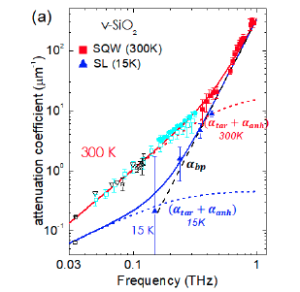
The quantitative results experimentally confirm the theoretically predicted quartic attenuation law with a prefactor that exhibits remarkable independence from temperature in the range 15-300 K, characteristic of an athermal process. This experimental value is satisfactory agreement with the prediction of the SPM model. Analysis of the acoustic field phase reveals significant negative dispersion, characterized by a decrease in phase velocity above 0.5 THz, in agreement with theoretical predictions.
The study also demonstrates the separation of distinct attenuation mechanisms. The athermal term in f⁴, associated with the boson peak and QLVs, adds to the known thermal contributions: thermally activated relaxation (TAR) processes dominant at low frequencies and anharmonic interactions with the thermal phonon bath. This decomposition clearly identifies the specific contribution of glass vibrational anomalies to acoustic attenuation.
These experimental approaches could be extended to other glasses and amorphous materials to test the universality of the phenomenon. It would also be interesting to explore the role of transverse modes, which dominate the vibrational density of states.
Reference
« Quartic Scaling of Sound Attenuation with Frequency in Vitreous Silica »
Peng-Jui Wang, Agnès Huynh, Jinn-Kong Sheu, Xavier Lafosse, Aristide Lemaître, Benoit Rufflé, René Vacher, Bernard Perrin, Chi-Kuang Sun, Marie Foret
Physical Review Letters, 134, 196101 (2025)
Caption:Attenuation of longitudinal waves as a function of frequency at 15 K (blue triangles) and 300 K (red squares). The other symbols are data from the literature: Brillouin scattering in the visible (squares) [56] and ultraviolet (triangle) [57,58], (star) [59] and acoustic ps (blue circles) [55], blue squares) [35]. The lines are derived from calculations of the different contributions to attenuation,
Contact
agnes.huynh(at)insp.jussieu.fr

