Light-Arthropod Interactions
 Arthropods species (insects, spiders, scorpions, etc.) account for nearly two-thirds of all living organisms on Earth. Present for hundreds of millions of years, they have adapted to absolutely every environment, especialy light environnements. From solar ultraviolet (A, B) to thermal mid-infrared, including the visible (human) spectrum, they have learned to manage these energy flows, protect themselves from them, detect them, and manipulate light. In short: to practice photonics! The photonic structures developed by arthropods adhere to nature’s fundamental principles: economy in the use of rapidly reusable chemical elements and multifunctionality at the cost of controlled complexity. They thus serve as a source of inspiration in numerous fields such as cosmetics, textiles, and energy…
After an introductory section covering general topics on arthropods and light, the book explores the three major electromagnetic regions present on Earth: ultraviolet, visible, and near- and mid-infrared.
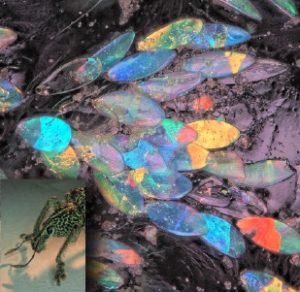
Caption: The colors of the scales of the Lamprocyphus augustus weevil are produced by a three-dimensional photonic structure. Most of the scales are single-crystalline.
Référence
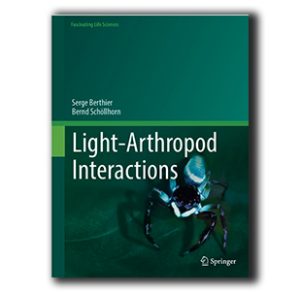
Light-arthropod interactions Serge Berthier, Bernd Schöllhorn Fascinating Life Sciences Springer (2026)
Contact
serge.berthier(at)insp.jussieu.fr

